
Engineering Example
Heat-Shield Attachment Optimization
Balancing structural performance, thermal management, and material efficiency through multi-objective optimization.
Multi-Objective
Stress, stiffness, and temperature balanced simultaneously.
Coupled Physics
Fully coupled thermomecihanics with pressure-dependent thermal contact.
Material Efficiency
High performance within a fixed material volume constraint.
The Engineering Challenge
Structural Loads
Carry applied pressure and transfer loads to the mounting structure.
Thermal Management
Conduct heat away from the component to the cooled mounting structure.
Weight Constraint
Meet performance objectives within a fixed material budget.
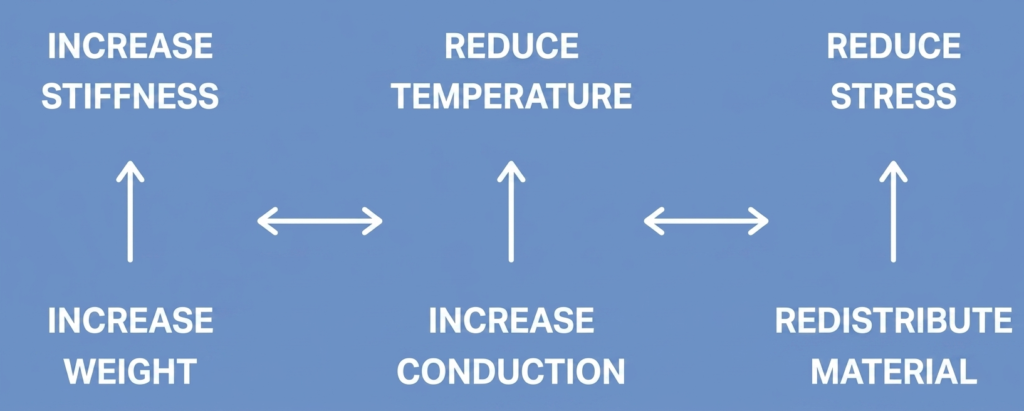
Why This Problem is Difficult
Increase Stiffness
Increase Weight
Reduce Temperature
Increase Conduction
Reduce Stress
Redistribute Material
Every design change influences all three objectives simultaneously.
The Optimized Design
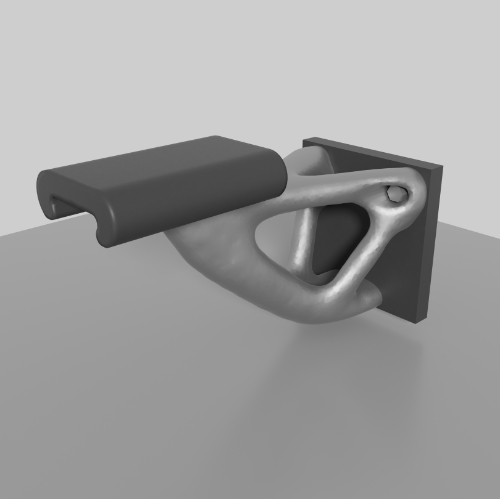
The optimized design naturally develops efficient load paths and a dedicated thermal path.
Two structural legs carry loads from the component interface, wrap around the attachment points, and triangulate back to the mounting structure.
A thicker central column provides a low-resistance conduction path that transfers heat to the cooled structure.

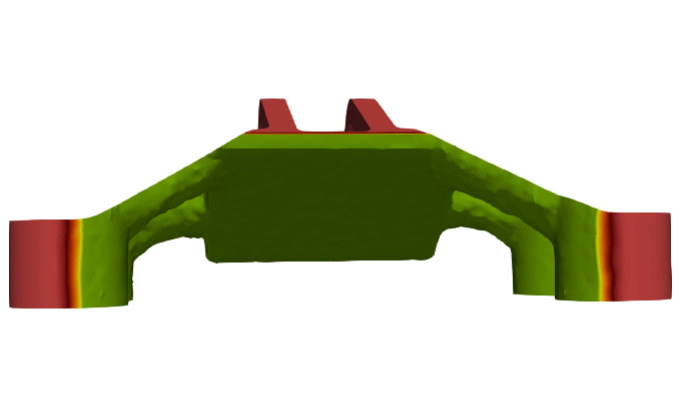
Structural Load Path
Side View
Material aligns along the primary load paths to transfer pressure into the mounting structure efficiently.
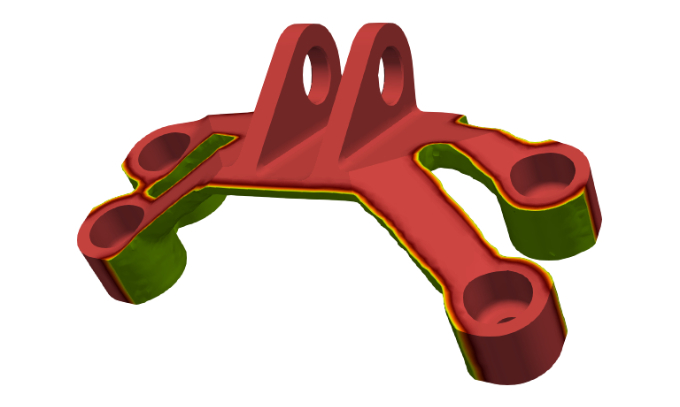
Heat Conduction Path
Top View
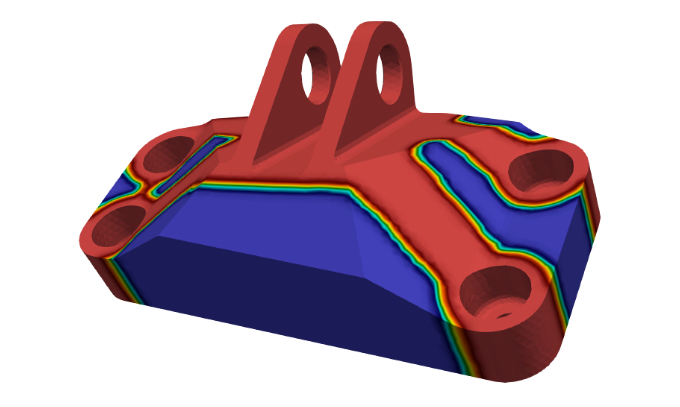
A continuous central pathway forms to conduct heat from the heated interface to the cooled mounting structure.
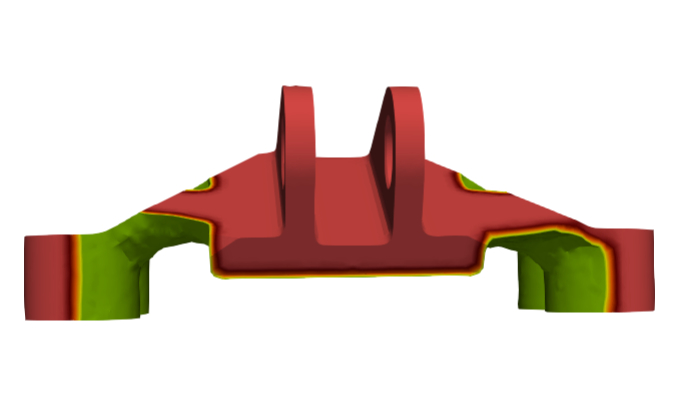
Joint Geometry
Front View
Material is placed where contact pressure is highest, maximizing both structural support and thermal conductance.
Overall Configuration
Oblique View
The final design balances structural and thermal objectives within the fixed material volume.
Why This Solution Works
The design balances thermal and structural performance. Heat flows primarily through the central column, keeping the structural members cooler.
Performance Objectives
01. Reduce Stress
Material is concentrated along principal load paths to minimize peak stress.
02. Increase Stiffness
Triangulated structural members maximize stiffness with minimal material.
03. Reduce Temperature
A continuous conduction path connects the heated interface to the thermal sink.
04. Maintain Material Budget
Topology optimization meets all objectives within the fixed volume constraint.
Engineering Insight
Pressure-dependent thermal contact
Thermal contact conductance depends on contact pressure. The optimizer places material so that regions that perform thermal work are also held in firm compression, where conductance is highest. Without modeling this effect, the design would rely on heat crossing lightly loaded or open regions, and real-world performance would degrade.
Model Capability Snapshot
Physics
Fully Coupled Thermomechanics
Contact
Pressure-Dependent Thermal Contact
Objectives
Stress, Stiffness, Temperature
Method
Density-Based Topology Optimization (SIMP)
Optimization
Adjoint Sensitivities + MMA
Constraint
Fixed Material Volume
Mesh
~338k Elements (~68k Nodes)
DOF
~273k (4 per node)
Runtime
~3 Hours on 8-Core Workstation